
Quick answers
What is scripting in manifestation?
Writing a first-person account of your wish already fulfilled, as a journal entry, a letter or a description of one moment. You write in the present tense or the past tense, never the future, and you include what you see, hear and feel.
How is scripting different from the 369 method?
Scripting is one longer passage, written once or rewritten now and then. The 369 method repeats one short sentence 3 times in the morning, 6 in the afternoon and 9 at night. Many people script first to find the words, then repeat the sentence.
Is there an app for scripting?
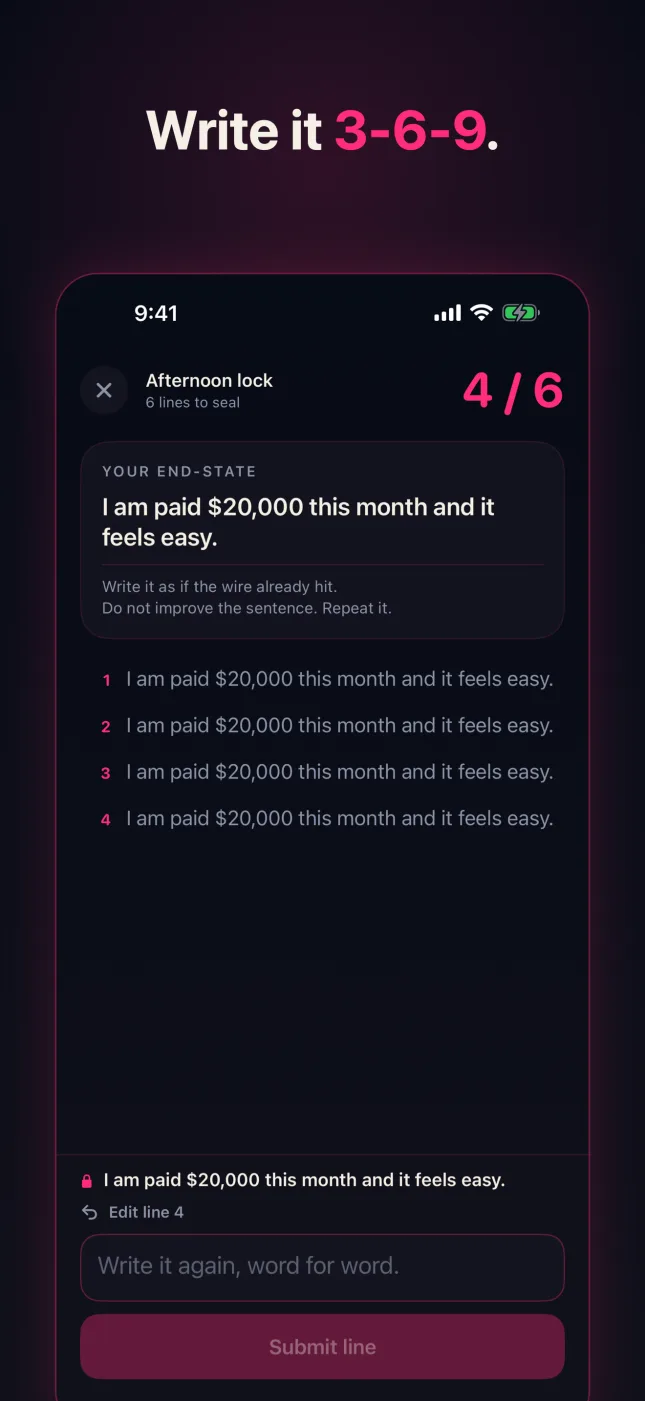
WishLock is an iPhone app for the short form. You lock one wish as a present-tense sentence and a short scene, with help on the wording, then type the sentence 3 times each morning and 6 each afternoon. It isn't a blank-page journal for long scripts.
What scripting is, and where it comes from
Scripting as a named technique is modern. It spread through books and social media about the law of attraction and the law of assumption. There's no single author and no official rulebook.
The idea behind it is older: imagine from the wish fulfilled, not toward it. That idea is often linked to the writer Neville Goddard, who taught picturing a short scene that implies the wish has happened. See SATS explained.
How to write a script, step by step
Pick one wish. One script, one subject. A script about a job, a house and a relationship reads like a list.
Choose one moment. Pick a scene that could only happen after the wish came true: signing the lease, the first morning at the new job, a friend congratulating you.
Write in the first person, in the present or past tense. "I'm unlocking the door" or "Today I got the keys." Never "I will" or "I hope".
Add what you sense: what you see, hear and touch. Two or three plain details beat a page of adjectives.
Add the feeling. Relief, pride, calm. Name it once, the way you'd tell a friend.
Keep it believable to you. If a line makes you roll your eyes, shrink it until you can write it with a straight face.
Stop. Half a page is enough.
A short example
A script for someone who wants a new apartment might read like this:
"Saturday. I'm drinking coffee by the big window in my new apartment. The light comes in over the park and the floor is warm under my feet. I signed the lease on Tuesday, and the rent is easy to cover. Maya came by last night and said it already feels like me. I feel at home."
That's one moment, a few details and one feeling. Nothing in it explains how it happened.
Four common formats
- A journal entry with a future date, written as if you're looking back on the day.
- A letter to a friend, telling them the news.
- A single scene: one short moment, described from the inside.
- A thank-you list: short lines of thanks for things as if they're done.
Pick the one that feels most natural. The single scene is the shortest, and the easiest to reuse at night.
How often to script
There's no rule. Three common approaches:
- Write it once, then reread it daily.
- Rewrite it every morning for a set number of days.
- Write one long script, then pull out one sentence and repeat that.
If daily rewriting starts to feel like homework, switch to the third. A short sentence you actually write beats a long script you skip.
Scripting, the 369 method and SATS
These three are often mixed up.
- Scripting: a passage, from a few lines to a page. It finds the words and the scene.
- The 369 method: one sentence, written 3, 6 and 9 times across the day. It builds the daily habit. Read how the 369 method works.
- SATS: a short scene you replay in your mind as you fall asleep. Read SATS explained.
A simple way to combine them: write a script once, underline the sentence that sums it up, repeat that sentence daily, and keep one moment from the script as your night scene.
Common mistakes
- Future tense. "I will" keeps the wish ahead of you.
- Writing the how. A script describes the end, not the route.
- Scripting to control a specific person. Keep it about your own life and your own state.
- Changing the wish every few days. Settle on it, then leave it.
- Checking for results after every session. That turns a calm practice into worry.
- Using a script in place of action. Write it, then go and do the next real thing.
What scripting can and can't do
There's no scientific evidence that writing a script changes outside events. What it reliably does is make you say exactly what you want, in plain words, and keep that in front of you.
Judge it by what it does to your attention and your actions. Keep your own record of what happens, and decide for yourself what counts.
When this is not the right tool
Scripting isn't a plan. For money, health or legal problems, get real advice and take real steps. A script can sit next to those, not replace them.
If scripting makes you more anxious, or you find yourself rewriting and checking for signs all day, stop for a while. If you're in distress, talk to someone you trust, a doctor or a therapist.
And if you want a blank page for long daily scripts, a notebook is the right tool. WishLock keeps one sentence and one short scene.
Frequently asked questions
Should a script be in the present tense or the past tense?
Either. Present tense puts you inside the moment. Past tense, like a diary entry about today, can feel more natural. The one tense to avoid is the future.
How long should a script be?
From a few sentences to a page. It needs to hold one clear moment and one feeling. If you plan to reread it every day, shorter is better.
Do I have to write by hand?
No. Handwriting is traditional, and typing works too. What matters is that you write the words yourself and pay attention as you write.
Can I script about more than one wish?
You can, in separate scripts. One wish per script keeps it clear. If you repeat a sentence every day, keep to one wish at a time.
Is WishLock free?
WishLock is free to download, and the daily practice is free: the 3-6-9 writing, the night session, help with the words, the proof log and the Assumption Score. WishLock Pro adds extras such as the scene read aloud every night and your own voice at night. The full list is below.
How WishLock does it
WishLock is an iPhone app from GW Labs. It doesn't hold long scripts. It keeps the two parts of a script you use every day, the sentence and the scene, and puts them on a schedule.
- One wish at a time: a single present-tense sentence, a short scene and a 21, 33 or 45-day cycle.
- Help with the words. Type the wish your own way and WishLock offers present-tense versions of your sentence and a short scene, written on your iPhone with Apple Intelligence, with guided prompts on every other iPhone. You pick and edit every word.
- 3-6-9 writing: 3 lines in the morning and 6 in the afternoon, typed, with no paste. The night is spent in the scene.
- A night session: your scene comes one line per breath over a calm soundscape. One minute seals the night.
- A proof log for what you notice, and an Assumption Score from 0 to 100.
- Your sentence as a Lock Screen wallpaper, plus widgets.
- Private: no account, no cloud, no ads. Your wish, scene, lines and proof never leave your iPhone.
- Free to download, with the daily practice free and the scene read aloud free on your first night. WishLock Pro adds the scene read aloud every night, your own voice at night, every Stats card, your proof as a PDF, a vault for parked wishes, two streak freezes a month and a weekly recap.
- WishLock is a practice tool for visualization, journaling and consistency. It doesn't promise outcomes.