
What the 369 method is
The whole method fits in three numbers. You write the same sentence:
- 3Morningtimes
- 6Afternoontimes
- 9Nighttimes
Same sentence, word for word, every time. That is 18 lines a day, a few minutes per session. The repetition is the point: you are not brainstorming or journaling, you are coming back to one fixed sentence until it reads like a plain description of your life rather than a hope. Most people keep a notebook for nothing else.
Think of it as a consistency practice. It asks for a little time three times a day, and it rewards the days you actually show up more than the days you write with great intensity.
Where the 3, 6 and 9 come from
The method is modern and spread mostly through social media. It is popularly linked to Nikola Tesla because of his reported fascination with the numbers 3, 6 and 9, and a line about those numbers is often shared as his. That line has no reliable source, and there is no record of Tesla teaching anything like this.
So treat the numbers as a structure that is easy to remember and spreads the practice across your day, not as a code. Nothing below depends on the numbers being special.
How to write your 369 sentence
The sentence does most of the work, so spend more time on it than on anything else. Four rules:
One wish. If you have three, choose the one you would keep if you could only keep one. A sentence that holds a job, a partner and a house reads like a list.
Present tense, already true. Write it as if it has happened: I am, I have, I live. Avoid "I want", "I will" and "I'm going to". They describe the wanting, which is the opposite of the point.
Include the feeling. Add how it feels to have it: "and it feels easy", "and I feel at home". The feeling is what you are really rehearsing.
Short enough to write nine times. One sentence, ideally under twenty words. If your hand cramps by the sixth line, cut it.
Examples
The last example shows one more rule: keep the sentence about your own life and your own state, not about controlling a specific person.
Run it as a 33-day cycle
Many people practice for a fixed cycle rather than open-ended, and 33 days is a common choice; 21 and 45 days are also used. A fixed length gives you an end point to aim for and stops you from rewriting the sentence every few days.
- Day 1: write the sentence, then leave it alone. Small wording changes reset the habit you are building.
- Keep the times steady: morning after you wake, afternoon after lunch, night just before bed. The night set is the one closest to sleep, so give it your quietest minutes.
- Note what changes: a conversation, an opportunity, a shift in how you feel about the wish. You decide what counts.
- At the end, review: read your notes, then start a new cycle with the same sentence, change it, or put it down.
Common mistakes
- Editing the sentence every day. Fix it once on day 1, then repeat it.
- Future tense or a request. "I will" and "please let" keep the wish in the future.
- Autopilot. Copying, pasting or writing while thinking about something else turns it into a chore. Read each line as you write it.
- Too many wishes. One sentence, one wish, one cycle.
- Checking for results after every session. Watching for proof every hour usually turns the practice into anxiety.
- Quitting after one missed session. A cycle with a gap is still a cycle.
Frequently asked questions
Does the 369 method work?
There is no scientific evidence that writing a sentence changes outside events. What the method reliably does is keep one goal in front of you, in your own words, three times a day, which many people find clarifying. Judge it by what it does to your attention and your actions, and keep your own record of what happens.
Is the 369 method from Nikola Tesla?
Only in popular culture. It is popularly linked to Tesla because of his reported fascination with the numbers 3, 6 and 9, but there is no record of him teaching a writing practice like this one, and the quote usually attached to it has no reliable source.
Do I have to write it by hand?
No. Handwriting is traditional, and typing works just as well if every line is actually typed. The rule that matters is no shortcuts: no copying and pasting the sentence.
What if I miss a session?
Do the next one. Some people restart the cycle after a missed day and others simply continue. Decide your rule before you start, so one missed afternoon doesn't end the whole practice.
Can I manifest more than one thing at once?
You can, but not in the same sentence, and ideally not in the same cycle. One wish keeps the sentence short enough to repeat 18 times a day and keeps your attention in one place.
What is the difference between the 369 method and scripting?
Scripting usually means writing a longer passage, like a journal entry from a life where the wish has already happened. The 369 method repeats one short sentence. Many people combine them: a script to find the right words, then the sentence for daily repetition.
How WishLock does the 369 method
WishLock is an iPhone app from GW Labs built around this practice. It keeps the structure and adds the parts that are hard to keep on paper.
- Lock one wish. One present-tense sentence, a short scene and a 21, 33 or 45-day cycle. Stuck on the words? Type the wish your own way and WishLock suggests present-tense versions (with Apple Intelligence on supported iPhones, guided prompts on others). You pick and edit every word.
- Typed lines, no paste. Morning ×3 and afternoon ×6, with a live counter and a haptic tick per line. Paste is off, so every line is typed, and a day is sealed only when the sessions are done.
- Night in the scene. Instead of nine written lines, the night is a short scene of the wish fulfilled, shown line by line over a calm soundscape; nine written lines stay as an optional warm-up. One minute seals the night. This is the SATS practice.
- A proof journal. Log synchronicities, money movement, invitations, inner shifts and inspired actions on the day they happen. When it happens, you mark it real: you decide what happened, and WishLock keeps the record.
- Private. No account. Your wish never leaves your iPhone, and share cards show numbers only.

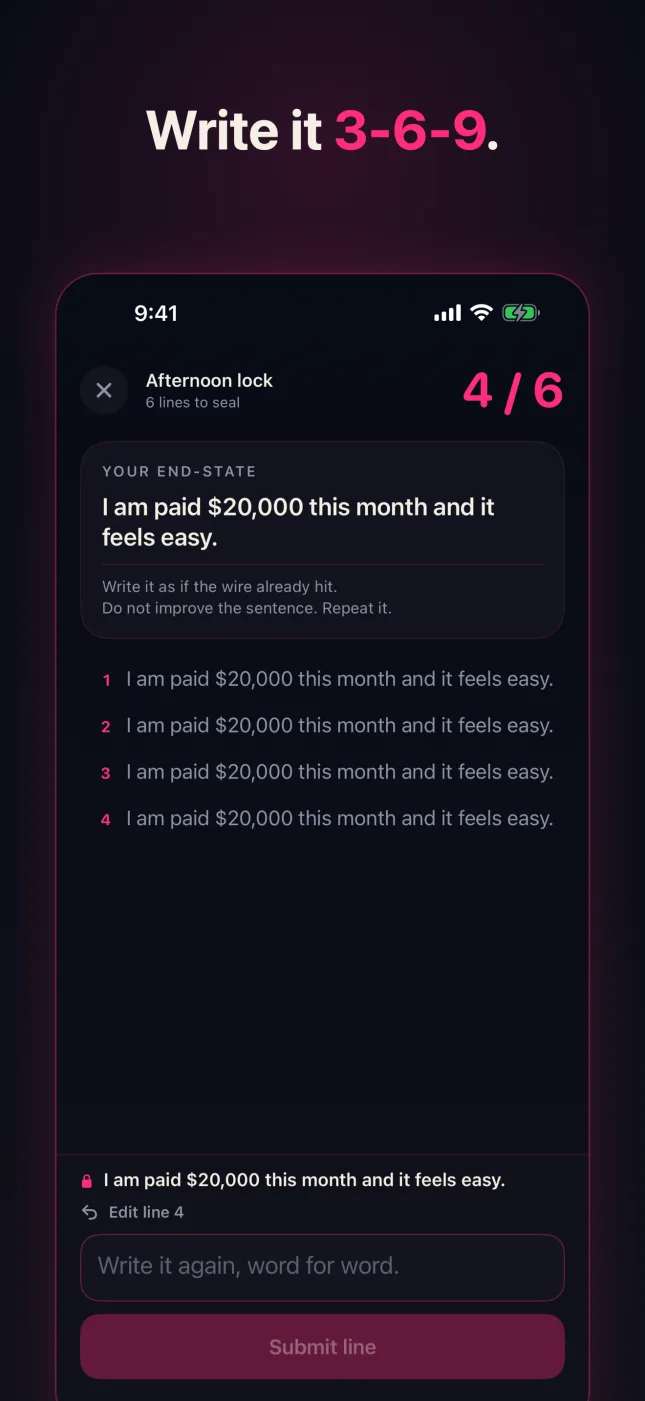
WishLock is free to download; WishLock Pro adds extras such as your scene read aloud every night. It is a practice tool for visualization, journaling and consistency, and it does not promise external outcomes.