
Who Neville Goddard was
Neville Goddard (1905–1972), usually known simply as Neville, was a writer and lecturer on imagination and what he called assumption. He taught for decades, mostly through public lectures, and his short books are still widely read; Feeling Is the Secret is a common place to start. Much of today's "law of assumption" vocabulary, SATS included, traces back to him. This guide paraphrases his ideas rather than quoting him.
What SATS is
SATS is the relaxed, drowsy state you pass through on the way to sleep: body heavy, attention soft, the mind still able to steer an image. Neville suggested using it on purpose. Lie down, relax until you are close to sleep, then imagine one short scene that could only happen if your wish were already fulfilled, and replay it until it feels natural.
Two details make it SATS rather than daydreaming. You are inside the scene, seeing it through your own eyes, not watching yourself on a screen. And the focus is the feeling of it being done: relief, ease, the ordinariness of something settled. You are not asking for anything.
The scene: short, specific, implying the wish
The scene is not a film of the whole wish. It is a moment that could only happen afterwards. Neville's examples are small and physical, such as a friend shaking your hand and congratulating you.
- A moment, not a story. About ten seconds: one place, one or two people, one exchange.
- Imply, don't describe. Rather than watching yourself sign the lease, stand in the new kitchen while someone asks where the glasses go.
- Use the senses. A sound, a touch, a sentence someone says.
- Loop it. The same scene, replayed, until it stops feeling new.
Examples
As with any wish practice, keep the scene about your own life. Build it on your experience, not on another person being made to act.
How to do SATS at night
Write the scene earlier in the day, so at night you are replaying, not inventing.
Lie down as if to sleep. Lights off, phone dimmed or face down.
Relax. Breathe slowly, with the exhale longer than the inhale, and let your body get heavy.
Step into the scene in the first person, as it happens.
Loop it. When it ends, start again. If your mind wanders, return to the first moment without judging.
Let sleep take you inside it. Drifting off mid-scene is the goal.
Living in the end
"Living in the end", often put as thinking from the end, is the daytime half of Neville's idea: carry the assumption that the wish is already fulfilled into ordinary life. In practice it is about attention. Notice when you think about the wish as missing, and ask how you would think, speak and act if it were already settled.
It isn't pretending your circumstances are different, and it isn't a reason to stop acting. Many people pair it with practical steps toward the same thing.
It fits naturally with the 369 method: the sentence keeps the end in front of you during the day, and SATS is the night practice built on feeling. Many people do both.
Frequently asked questions
What does SATS stand for?
SATS stands for "state akin to sleep": the relaxed, drowsy state just before you fall asleep. Neville Goddard taught it as the best moment to imagine a scene that implies your wish is fulfilled.
How long should SATS take?
There is no fixed length. A minute or two of real attention counts, and many people keep looping the scene until they fall asleep. Doing it most nights matters more than doing it for long.
What if I fall asleep during SATS?
That is the intended ending. In Neville's approach you fall asleep inside the scene, so drifting off mid-loop is not a failure.
Can I do SATS during the day?
Yes, whenever you can relax deeply, for example lying down before a nap. Night is traditional because you are already drifting toward sleep.
How is SATS different from visualization?
General visualization often pictures a goal from the outside or as a long sequence. SATS uses one short scene that happens after the wish is fulfilled, felt in the first person, repeated in a near-sleep state.
Does SATS work?
There is no scientific evidence that imagining a scene changes outside events. As a practice it is a nightly rehearsal of a feeling and a way to end the day with one clear intention. Keep your own record and decide for yourself.

How WishLock's guided night works
WishLock is an iPhone app from GW Labs that builds its night session around SATS. The night opens after your morning and afternoon 3-6-9 sessions, at 8 PM by default.
- Write the scene once. A few short lines: where you are, who is there, what is said or felt. Apple Intelligence can draft it from your own words on supported iPhones, with guided prompts on others. You edit every word.
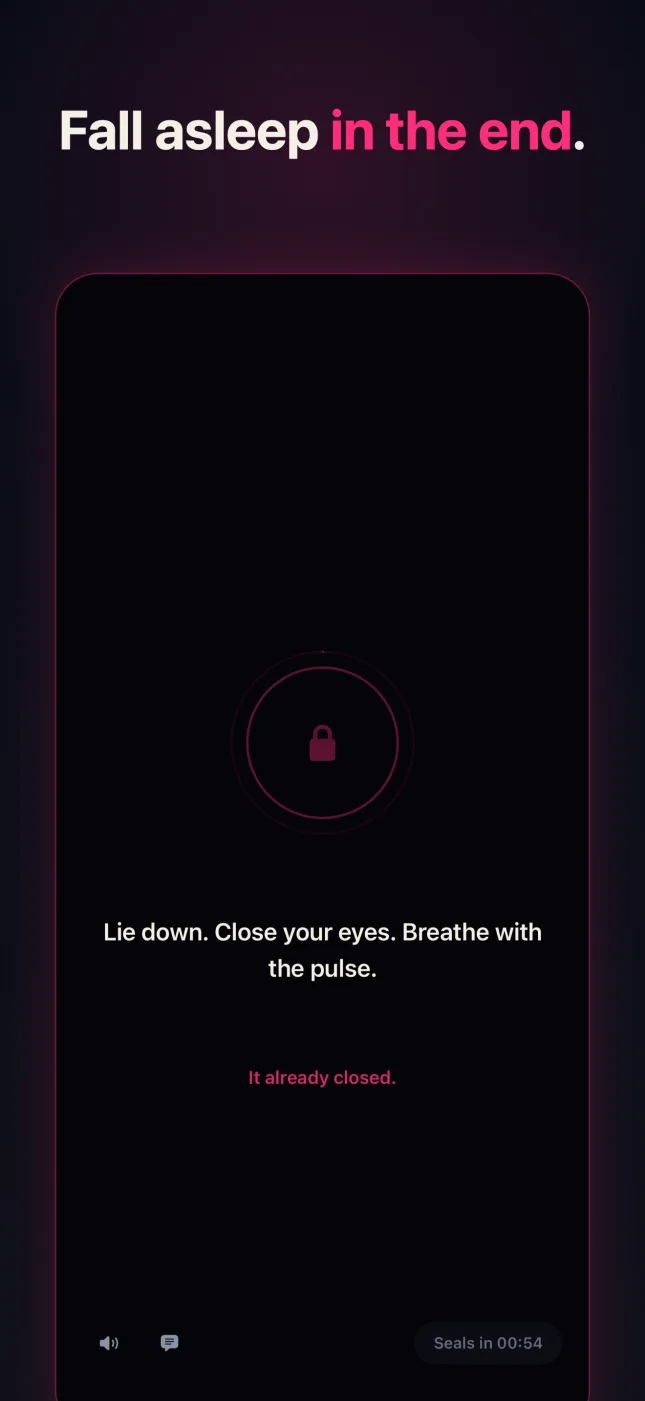
- Your scene, line by line. A five-second intro (lie down, close your eyes, breathe with the pulse), then one line per slow breath over a calm soundscape made on the iPhone. Long scenes loop, and the screen sinks toward black.
- A narrator if you want one. A calm voice on your iPhone reads the scene slowly, then your sentence once. Your first narrated night is free; after that it is part of WishLock Pro, which can also use your own recorded voice.
- One minute seals the night. One soft cue marks it. Choose 3, 8 or 20 minutes to keep going and fall asleep inside the scene.
- Rate how real it felt, from 1 to 5. The rating feeds your Assumption Score, a 0–100 measure of your practice, not of outcomes.
No account, and your scene never leaves your iPhone.

WishLock is free to download; WishLock Pro adds the scene read aloud every night and more night sounds. It is a practice tool for visualization, journaling and consistency, and it does not promise external outcomes.