
Quick answers
What is revenge bedtime procrastination?
Putting off sleep to get time for yourself after a day with none. Nothing is stopping you from going to bed. You stay up anyway, usually on your phone or with a show, and pay for it the next morning.
Why do I stay up late even when I'm tired?
Because late evening is often the only time nobody needs anything from you. Going to bed ends that time, so you delay it. Being tired also makes it harder to stop, which is why the delay grows.
Is there an app that helps with revenge bedtime procrastination?
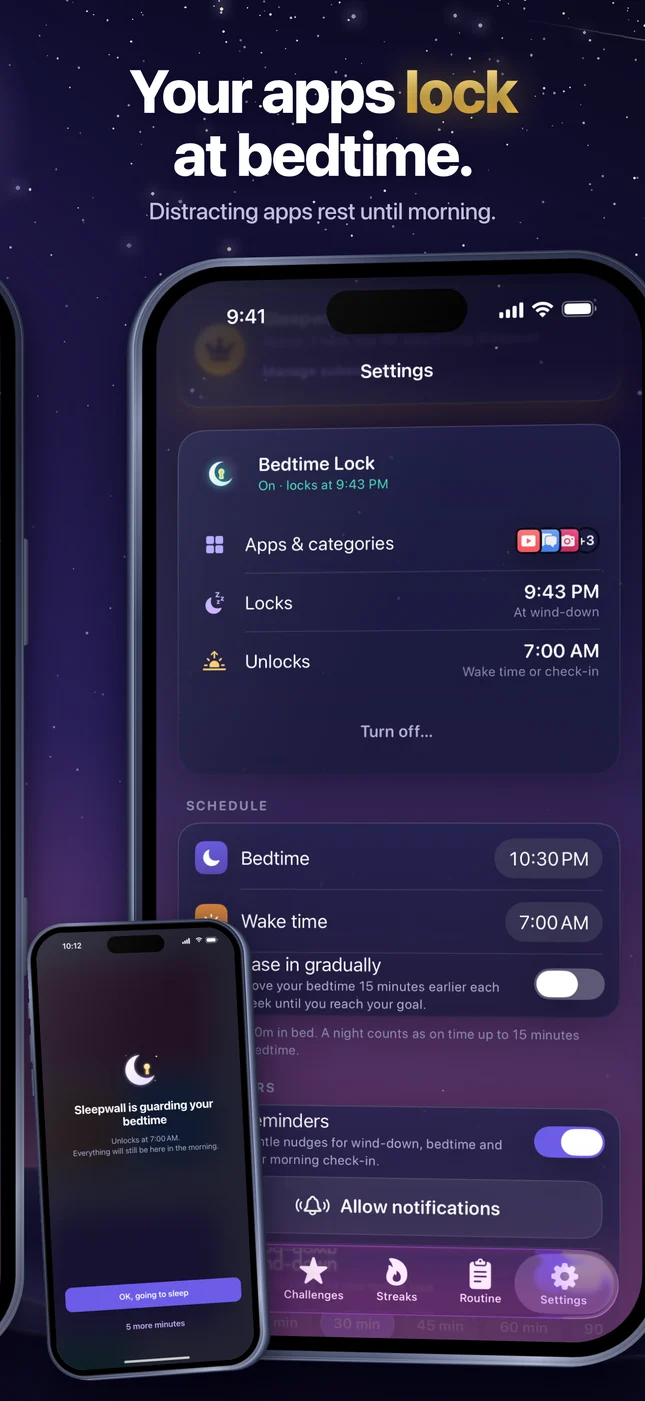
Sleepwall is an iPhone app built around bedtime. The apps you pick lock at wind-down or bedtime, and a guided wind-down with timers, calm breathing and sleep sounds takes their place. The wind-down is free, and Bedtime Lock is free for one night, one time.
Where the term comes from
"Bedtime procrastination" was named in a 2014 study by researchers at Utrecht University. They defined it as "failing to go to bed at the intended time" when no outside circumstances prevent it. In their survey of 177 people, it was linked to lower self-regulation and to reports of not getting enough sleep.
The word "revenge" came later, online. It names the motive: taking hours back from a day that took all of yours. It describes a habit. It isn't a diagnosis.
Signs it's you
- You could go to bed. Nothing outside you is keeping you up.
- You know you'll be tired tomorrow, and you stay up anyway.
- The late hours feel like the only time that's yours.
- What you do with them is passive: scrolling, shows, games.
- You feel a small resentment at the idea of "just going to bed".
If you're in bed, trying to sleep and can't, that's a different problem. See "When this is not the right tool" below.
Why it happens
- The day has no time that's yours. Work, family and chores take the hours until late.
- Bedtime feels like a loss. Sleep ends the only free part of the day and starts the next full one.
- You're tired. Stopping takes self-control, and there's less of it late at night.
- The phone makes it effortless. No setup, no end point, always within reach.
It isn't laziness. It's an understandable reaction to an overfull day, with a cost that arrives the next morning.
What it costs
The CDC says adults aged 18 to 60 need 7 or more hours of sleep a night. An hour taken at midnight comes straight out of that.
It also feeds itself. A short night makes the next day harder, a harder day leaves you wanting more time back, and you stay up again. The plan below breaks that loop at the start of the evening, not the end.
An eight-step plan
1. Name the time you're taking back
How much do you actually want? For many people it's 30 to 60 minutes with no demands. Write the number down. It's a fair thing to want.
2. Take it earlier
Put that time in your evening on purpose, before you're worn out: straight after dinner, or as soon as the kids are in bed. Treat it like an appointment. Time you chose feels different from time you stole.
3. Set a wind-down time, not only a bedtime
Pick the time the evening ends, 30 to 60 minutes before bed, and set an alarm for it. The NHLBI suggests using the hour before bed for quiet time.
4. Choose things that end
An episode ends. A chapter ends. A feed doesn't. For your free time, pick things with a natural stopping point.
5. Lock what doesn't end
At your wind-down time, lock the apps that have no last page, or put the phone in another room. Decide this earlier in the day. For the full method, read how to stop scrolling in bed.
6. Make the wind-down something you like
If the wind-down feels like one more chore, you'll skip it. Keep it short and pleasant: a shower, a paper book, slow breathing, a steady sound. The NHS says a calm bedtime routine can help you prepare for sleep.
7. Move your bedtime in small steps
If you go to bed at 1:00 and want midnight, don't jump. Move 15 minutes earlier each week. Small changes hold.
8. Forgive the miss
You'll stay up late some nights. Note it and go back to the plan the next evening. One late night doesn't cancel the others.
If the day really has no room
Sometimes there is no free hour to move. Then the honest answer isn't a bedtime trick. Look at what can change: a chore shared, one commitment dropped, a talk with your manager about workload, twenty minutes at lunch that's yours. A little real free time in the day takes pressure off the night.
When this is not the right tool
This guide is for people who put off going to bed. It doesn't fit every late night.
- You go to bed and can't sleep. The NHS lists finding it hard to go to sleep and lying awake at night among the signs of insomnia. That's a sleep problem, not procrastination.
- You work shifts, or you're up with a baby or someone you care for. Outside circumstances are keeping you up.
- You've had trouble sleeping for months, or it's making daily life hard to cope with. The NHS says to see a GP.
A habit app or a plan isn't medical care. If you're unsure, ask a doctor.
Frequently asked questions
Is revenge bedtime procrastination a medical condition?
No. It's a name for a habit: choosing to stay up when nothing is stopping you from going to bed. If sleep is a regular problem for you, talk to a doctor.
Is it the same as insomnia?
No. With insomnia, you try to sleep and can't. With bedtime procrastination, you put off trying. They need different answers, and insomnia is something to raise with a doctor.
Does it only happen with phones?
No. People stay up with TV, games, books, cleaning or just sitting in the quiet. Phones make it easier, because a feed never ends and the phone is always in reach.
How much sleep do adults need?
The CDC says 7 or more hours a night for adults aged 18 to 60, 7 to 9 hours for ages 61 to 64, and 7 to 8 hours for 65 and older.
Is Sleepwall free?
Sleepwall is free to download. Bedtime Lock is free for one night, one time. The guided wind-down, sleep sounds, one-tap check-ins, streaks, levels, quests, badges and the weekly recap are free. Sleepwall Pro adds Bedtime Lock every night, insights, smart nudges, themes and export.
How Sleepwall does it
Sleepwall is an iPhone app from GW Labs for getting to bed on time. It's a habit tool, not a sleep treatment.
- A personal plan from day one, with an optional ease-in that moves your bedtime 15 minutes earlier each week.
- An evening countdown to wind-down and bed.
- A guided wind-down: your routine one step at a time, with timers and calm breathing.
- Sleep sounds generated on your iPhone: brown noise, pink noise, soft rain and gentle waves, with a sleep timer that fades out.
- Bedtime Lock: the apps you pick lock at wind-down or bedtime and stay locked until your wake time or your morning check-in, with "5 more minutes" once a night.
- A streak for on-time nights. A 15-minute grace window and streak freezes forgive an off night.
- Private: no account and no ads. Your sleep logs stay on your iPhone.
- Free: Bedtime Lock for one night, one time, plus the guided wind-down, sleep sounds, check-ins, streaks, levels, quests and badges. Sleepwall Pro adds Bedtime Lock every night, insights over 7, 14, 30 and 90 days, smart nudges, themes and PDF or CSV export. Pro is weekly, monthly, yearly or a one-time lifetime purchase.