
What no contact means
No contact is simple to say and hard to do. For the length you choose, it means:
- No texts, calls, emails or DMs, including "just checking in" and "happy birthday".
- No likes, comments or reactions, and no watching their stories.
- No checking their profiles, and no messages through mutual friends.
Thirty days is a common starting goal. Many people go longer, and some never go back to being in touch.
Why people do it
After a breakup, every message brings back a little hope and then the hurt that follows it. No contact breaks that loop. With some distance it gets easier to see the relationship clearly, to grieve it and to put your attention back on your own life.
Some advice online sells no contact as a tactic to win an ex back. It works best as what it is: a way to move on. If you get back together later, it should be because things changed, not because you went silent for a month.
How to start
Pick a length and write it down. 30 days is a good first goal. You can extend it when you get there.
Decide what to do with their messages. Mute, archive or block: choose the option that keeps you from checking. Muting and archiving can be undone later; you don't have to delete anything today.
Remove the easy triggers. Mute their profiles, move photos out of your camera roll into a folder, and turn off notifications that show their name.
Tell one person. A friend who knows you're doing this is someone to text instead.
Plan the first 24 hours. The first day and the first weekend are usually the hardest. Fill them on purpose.
When you want to reach out
The urge to text usually passes if you can get through the next few minutes. Ways to get there:
- Wait ten minutes before deciding anything. Set a timer.
- Breathe slowly, with a longer breath out than in, for a couple of minutes.
- Write the message you want to send, and don't send it. An unsent letter lets you say all of it.
- Text your friend instead.
- Notice what set it off: a song, a date, being tired, a weekend night. Next time you'll see it coming.
If you break no contact
It happens. Don't use one message as a reason to give up. Start again from today, write down what led to it, and plan for that moment next time. Your longest streak still counts.
When no contact isn’t possible
If you share children, a job, a lease or a business, full no contact may not be realistic. Many people use limited contact instead: only what's needed, in writing where possible, short and about logistics. Keep conversations about the kids, the work or the move, and leave the relationship out of it.
If the relationship was abusive or you feel unsafe, leaving safely comes first, and that can take more planning than no contact alone. In the U.S., the National Domestic Violence Hotline is at 1-800-799-7233. If you're in crisis, call or text 988, or call 911 in an emergency.
Frequently asked questions
How long should no contact last?
Thirty days is a common first goal. Many people extend it to 60 or 90 days, or longer, once they get there.
Should I block my ex?
If you keep checking or reaching out, blocking makes it easier. Muting and archiving work too, and can be undone later.
What if my ex contacts me?
You don’t have to reply. If you share responsibilities, keep the reply short and about logistics only.
Does liking their post break no contact?
Yes. Likes, comments, story views and reactions are all contact.
Does no contact work?
It doesn’t guarantee any outcome with your ex. What it does is give you space to stop the cycle of hope and hurt and to start moving on.
What is No-Contact November?
A month-long no-contact challenge from November 1 to 30, for anyone who wants a clear start date and a finish line.

How Heal does it
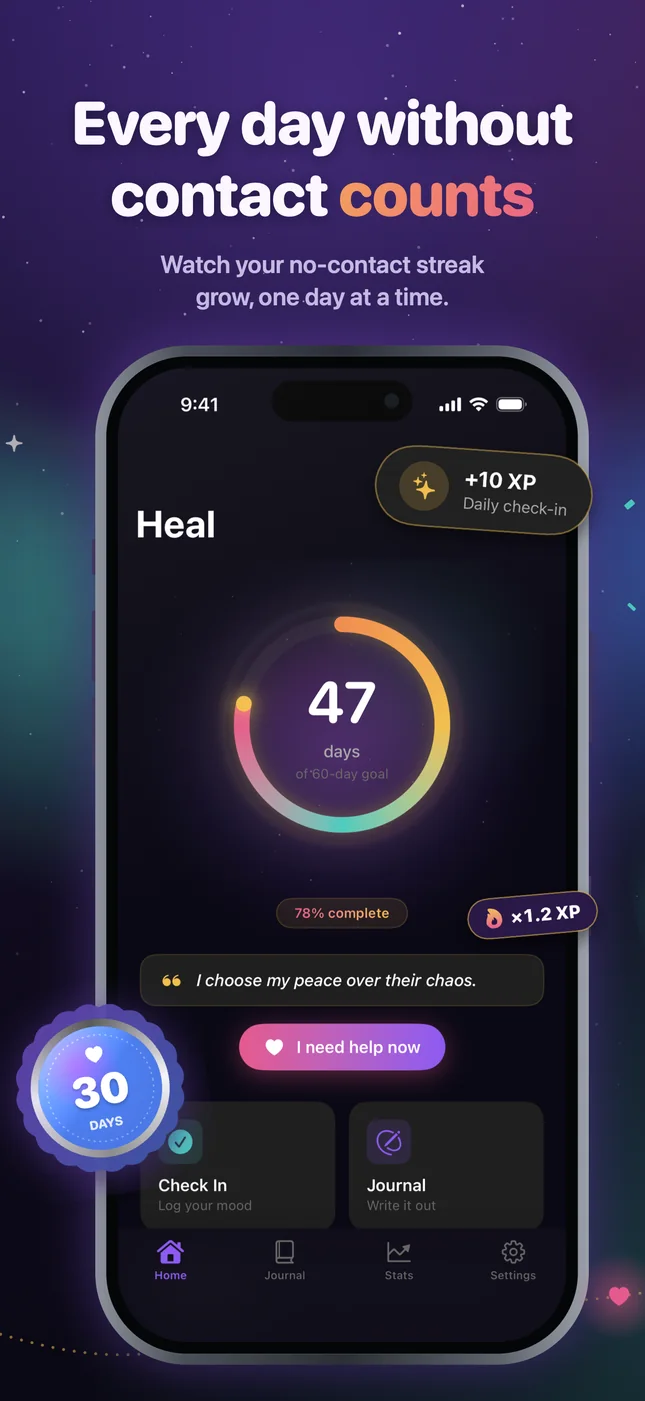
Heal is an iPhone app from GW Labs built for the no-contact rule. It isn’t therapy or medical care; it’s a tool for getting through each day.
- Your no-contact streak. A ring that fills toward the goal you choose, from 14 days to a full year or any number of days you pick, with a medal at every milestone.
- SOS when you want to reach out. Guided breathing, coping strategies and a way to rate the urge. Every urge you resist is counted.
- An honest daily check-in. Did you contact your ex today? If you did, the streak resets, your best streak stays on record, and a reset tapped by mistake can be undone within 48 hours.
- Unsent letters and a private journal. Say all of it and seal it. It never gets sent.
- Challenges. No-Contact November (November 1–30), a 30-Day Challenge you can start any day, the Holiday Challenge and Valentine's Week.
- Private. No account. Your entries stay on your iPhone, with an optional Face ID, Touch ID or passcode lock.

Heal is free to download; Heal Premium adds insights, PDF export and daily encouragement reminders. Heal is a self-help tool, not therapy or medical care.